Join the movement to end censorship by Big Tech. StopBitBurning.com needs donations and support.
Don't read this if you're vaccinated
By newseditors // 2022-06-21
Mastodon
 Parler
 Gab
Gab Copy
Copy
mRNA Covid vaccines offer essentially no defense against Omicron only months after a booster shot, according to a major new study from British researchers.
(Article by Alex Berenson republished from AlexBerenson.Substack.com)
Both antibody and T-cell protection are nearly non-existent, the scientists found.
In an even more worrisome development, when vaccinated but previously uninfected people suffer breakthrough Omicron infections, their T-cell response is biased toward earlier versions of Sars-Cov-2 - not to the Omicron variant that has actually infected them.
In other words, the mRNA shots appear to permanently wrongfoot the immune systems of people who receive and bias them toward producing T-cells to attack variants that no longer exist - even though they never were infected with those variants at all.
The T-cell problems are particularly surprising and worrisome.
While antibodies are the first line of defense against infection and try to clear the virus from the bloodstream, T-cells are the crucial second line. They attack and destroy infected cells and also work with other parts of the immune system to produce more and better targeted antibodies later.
Vaccine advocates have claimed endlessly that mRNA-generated T-cells help keep people from becoming severely ill with Covid even after frontline antibody protection against infection disappears.
This study suggests that supposed protection may be a myth, and the low death rates from Omicron are simply a result of Omicron’s general lack of virulence in vaccinated and unvaccinated people alike.
—
The study also provides additional evidence that the way the mRNA shots work may leave vaccinated people even more vulnerable to infection and reinfection over time.
The jabs cause people to make one type of coronavirus antibodies. But the study suggested the immune system’s ability to beat the virus also depends on other antibodies - and the shots hamper the production of those.
Scientists have been loathe to admit, much less discuss, the potential long-term problems that mRNA vaccine suppression of broad antibody production may cause.
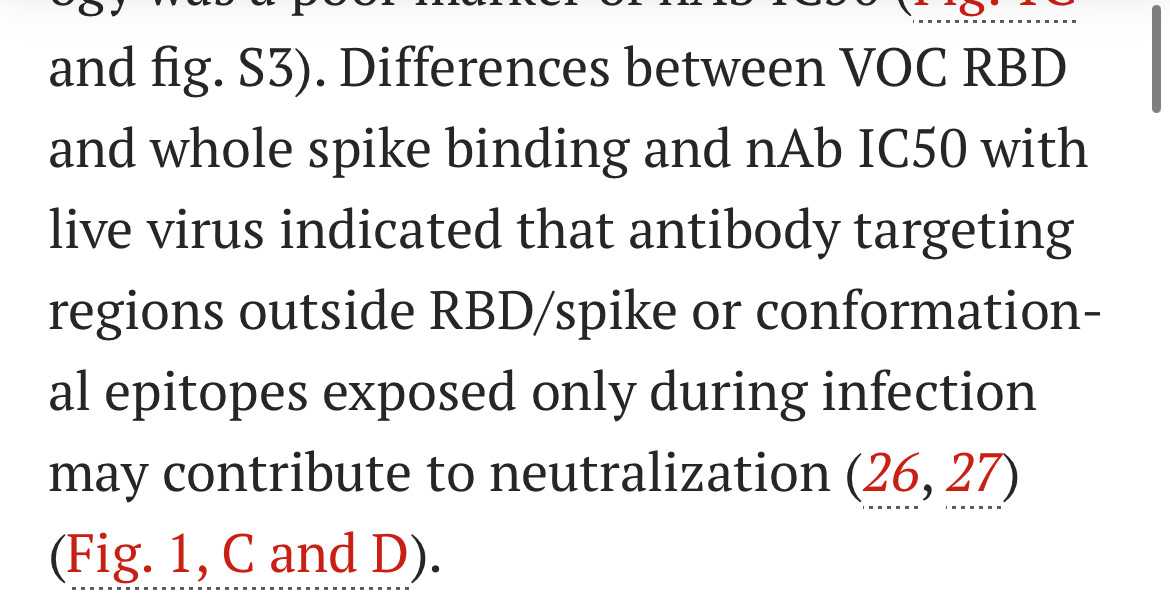
In this case, though, the authors were concerned enough to acknowledge the issue. They wrote that overall immunity may benefit from parts of the coronavirus that are “exposed only during infection.” Even so, they buried that warning in highly technical language deep in the paper, a sign of the political sensitivities that surround any criticism of the vaccines.
 SOURCE
—
The prestigious journal Science published the paper, which is based on analysis of antibodies and B- and T-cells in a group of British healthcare workers whom the researchers have followed since March 2020.
The researchers were focused primarily on Omicron’s potential to cause reinfections in vaccinated people who had already been infected with earlier variants of Covid. But they also examined its potential to cause first-time infections in previously uninfected but vaccinated people. Those are the findings that are most interesting for anyone interested in vaccine failure.
Unfortunately but unsurprisingly, the scientists did not look at the immune responses of anyone who was not vaccinated - with or without previous infection. Thus the paper offers no direct comparison of the way Omicron may affect antibody and B- and T-cell responses in vaccinated and unvaccinated people.
Why didn’t the researchers include unvaccinated people? Maybe because nearly all British adults are vaccinated and most boosted, so the authors wanted to concentrate on the risks Omicron poses to vaccinated people.
Or maybe because they worried about what they’d find if they directly compared the two groups.
—
Nonetheless, the paper shows clearly that vaccinations and booster doses offer at most a few weeks of protection against Omicron.
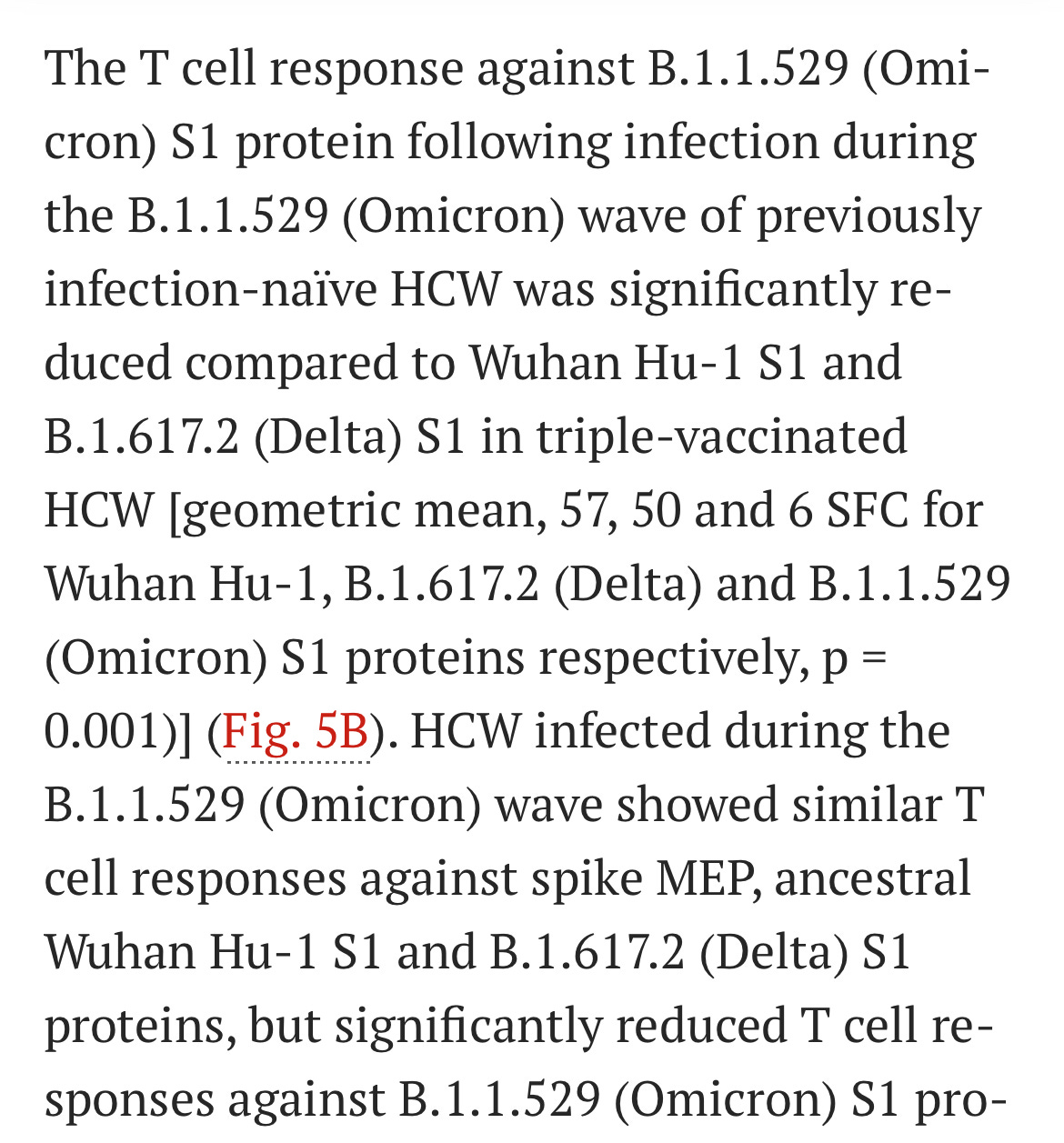
None of the “triple-vaccinated, infection naive” people the researchers studied had antibodies able to neutralize Omicron within 14 weeks after the third dose. And the researchers found a T-cell response to Omicron in only 1 of 10 people who had been triply vaccinated but not previously infected.
In addition, the researchers found that a group of previously uninfected but vaccinated people who then became infected with Omicron had a much stronger T-cell response to earlier variants.
SOURCE
—
The prestigious journal Science published the paper, which is based on analysis of antibodies and B- and T-cells in a group of British healthcare workers whom the researchers have followed since March 2020.
The researchers were focused primarily on Omicron’s potential to cause reinfections in vaccinated people who had already been infected with earlier variants of Covid. But they also examined its potential to cause first-time infections in previously uninfected but vaccinated people. Those are the findings that are most interesting for anyone interested in vaccine failure.
Unfortunately but unsurprisingly, the scientists did not look at the immune responses of anyone who was not vaccinated - with or without previous infection. Thus the paper offers no direct comparison of the way Omicron may affect antibody and B- and T-cell responses in vaccinated and unvaccinated people.
Why didn’t the researchers include unvaccinated people? Maybe because nearly all British adults are vaccinated and most boosted, so the authors wanted to concentrate on the risks Omicron poses to vaccinated people.
Or maybe because they worried about what they’d find if they directly compared the two groups.
—
Nonetheless, the paper shows clearly that vaccinations and booster doses offer at most a few weeks of protection against Omicron.
None of the “triple-vaccinated, infection naive” people the researchers studied had antibodies able to neutralize Omicron within 14 weeks after the third dose. And the researchers found a T-cell response to Omicron in only 1 of 10 people who had been triply vaccinated but not previously infected.
In addition, the researchers found that a group of previously uninfected but vaccinated people who then became infected with Omicron had a much stronger T-cell response to earlier variants.
 —
As is typical with papers that present findings this damning, the researchers did not explicitly draw the most worrisome conclusions their data suggests.
But they did openly suggest the fact that the immune response in vaccinated people is biased toward earlier coronavirus variants rather than Omicron even in people who weren’t infected with those earlier variants could help explain “frequent B.1.1.529 (Omicron) reinfections with short time intervals between infections are proving a novel feature in this wave.”
Less clear is what, if anything, anyone can do about this imprinting. The authors noted that efforts by vaccine makers to produce newer mRNA shots that cause the body to produce the Omicron spike have largely failed to overcome the problem, probably for the same reason - the initial imprinting is too strong.
In the meantime, though, Omicron remains relatively mild. As long as it does not mutate to become more dangerous, vaccine advocates can continue to pretend that the billion-person clinical trial of 2021 is not ending catastrophically.
Read more at: AlexBerenson.Substack.com
—
As is typical with papers that present findings this damning, the researchers did not explicitly draw the most worrisome conclusions their data suggests.
But they did openly suggest the fact that the immune response in vaccinated people is biased toward earlier coronavirus variants rather than Omicron even in people who weren’t infected with those earlier variants could help explain “frequent B.1.1.529 (Omicron) reinfections with short time intervals between infections are proving a novel feature in this wave.”
Less clear is what, if anything, anyone can do about this imprinting. The authors noted that efforts by vaccine makers to produce newer mRNA shots that cause the body to produce the Omicron spike have largely failed to overcome the problem, probably for the same reason - the initial imprinting is too strong.
In the meantime, though, Omicron remains relatively mild. As long as it does not mutate to become more dangerous, vaccine advocates can continue to pretend that the billion-person clinical trial of 2021 is not ending catastrophically.
Read more at: AlexBerenson.Substack.com
SOURCE
—
The prestigious journal Science published the paper, which is based on analysis of antibodies and B- and T-cells in a group of British healthcare workers whom the researchers have followed since March 2020.
The researchers were focused primarily on Omicron’s potential to cause reinfections in vaccinated people who had already been infected with earlier variants of Covid. But they also examined its potential to cause first-time infections in previously uninfected but vaccinated people. Those are the findings that are most interesting for anyone interested in vaccine failure.
Unfortunately but unsurprisingly, the scientists did not look at the immune responses of anyone who was not vaccinated - with or without previous infection. Thus the paper offers no direct comparison of the way Omicron may affect antibody and B- and T-cell responses in vaccinated and unvaccinated people.
Why didn’t the researchers include unvaccinated people? Maybe because nearly all British adults are vaccinated and most boosted, so the authors wanted to concentrate on the risks Omicron poses to vaccinated people.
Or maybe because they worried about what they’d find if they directly compared the two groups.
—
Nonetheless, the paper shows clearly that vaccinations and booster doses offer at most a few weeks of protection against Omicron.
None of the “triple-vaccinated, infection naive” people the researchers studied had antibodies able to neutralize Omicron within 14 weeks after the third dose. And the researchers found a T-cell response to Omicron in only 1 of 10 people who had been triply vaccinated but not previously infected.
In addition, the researchers found that a group of previously uninfected but vaccinated people who then became infected with Omicron had a much stronger T-cell response to earlier variants.
—
As is typical with papers that present findings this damning, the researchers did not explicitly draw the most worrisome conclusions their data suggests.
But they did openly suggest the fact that the immune response in vaccinated people is biased toward earlier coronavirus variants rather than Omicron even in people who weren’t infected with those earlier variants could help explain “frequent B.1.1.529 (Omicron) reinfections with short time intervals between infections are proving a novel feature in this wave.”
Less clear is what, if anything, anyone can do about this imprinting. The authors noted that efforts by vaccine makers to produce newer mRNA shots that cause the body to produce the Omicron spike have largely failed to overcome the problem, probably for the same reason - the initial imprinting is too strong.
In the meantime, though, Omicron remains relatively mild. As long as it does not mutate to become more dangerous, vaccine advocates can continue to pretend that the billion-person clinical trial of 2021 is not ending catastrophically.
Read more at: AlexBerenson.Substack.com
Mastodon
Parler
Gab
Copy
Tagged Under:
immune system Big Pharma research vaccine damage vaccine injury vaccine pandemic truth outbreak infections Dangerous Medicine badscience badhealth badmedicine COVID mRNA pharmaceutical fraud booster omicron
You Might Also Like




Deborah Birx hid covid info from Trump, altered CDC guidelines without approval
By Ethan Huff // Share

Germany’s birth rate improbably falls by 11% in the first quarter of 2022
By Lance D Johnson // Share

By Mary Villareal // Share
Recent News

Lactic acid bacterium shows promise in flushing nanoplastics from the body
By willowt // Share

Rubio blocked Iran peace deal during April talks in Pakistan, reports say
By isabelle // Share
Teenage Dutch suspects arrested as string of explosions rattles Frankfurt
By isabelle // Share

New study links nighttime coughing to air pollution, even in “clean” cities
By isabelle // Share

Trucking’s Triple Crisis: Diesel Prices, Regional Scarcity, and the Autonomous Threat
By healthranger // Share

Popular This Week