 Parler
 Gab
Gab Copy
Copy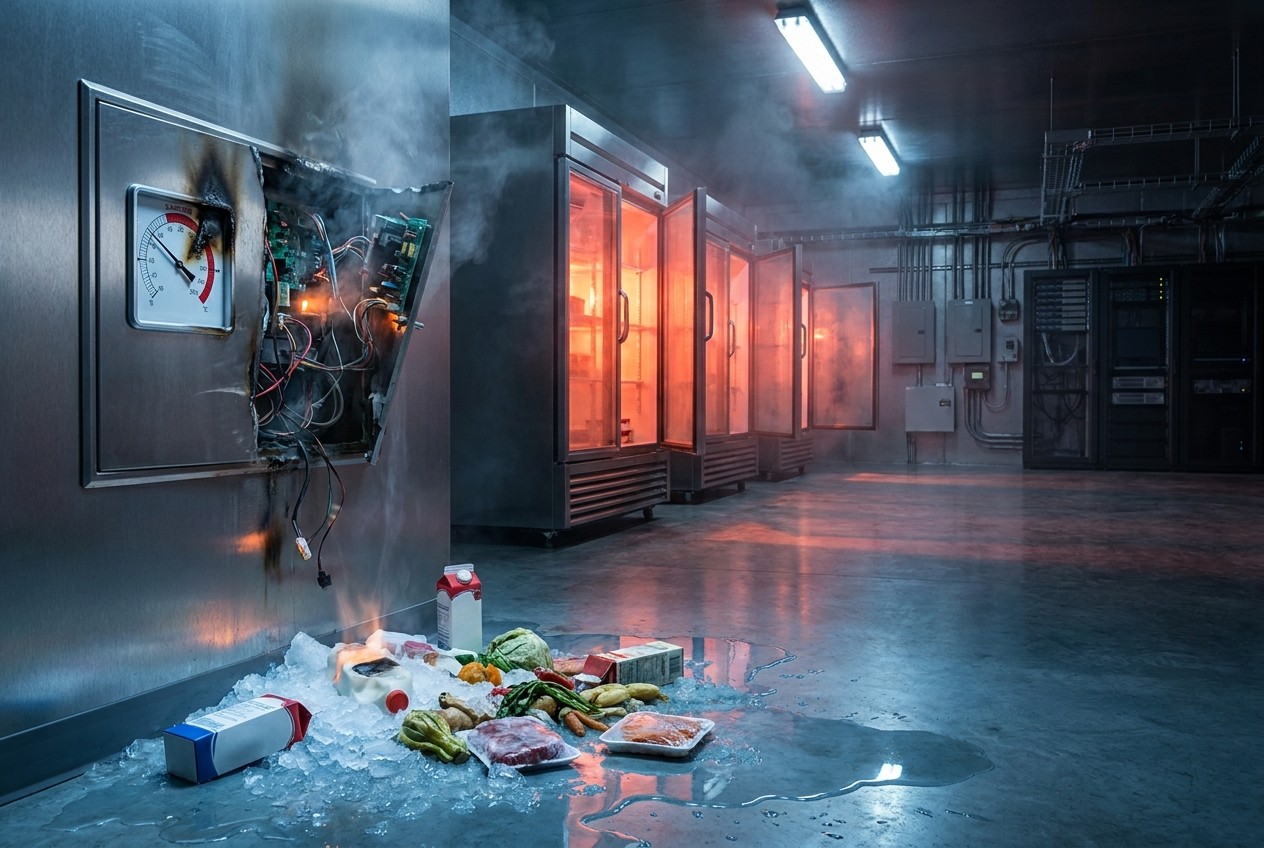
When Your Password is Today's Date, You're Inviting Intrusions
I've read the headlines streaming out of France this week, and I don't buy the scary, sophisticated-hacker framing for a second. Hundreds of French supermarkets had their fridges and freezers hijacked, with temperatures forced as high as 50 degrees Celsius, which is 122 degrees Fahrenheit [1]. The food losses are being described as worth millions of euros [2]. But when you peel back the breathless coverage and look at what actually happened, this wasn't a cyberattack in any meaningful sense of national-security seriousness. These were refrigerator controllers -- Danish-made Danfoss AK-SM800 and AK-SC355 regulator systems -- that investigators determined to be the attack surface [3]. They login username was "admin" and the password was set to today's date, updated each day. Bypassing that wasn't a hack. It was very nearly just stumbling into a login like falling into a pothole. Whether an insider was sending a message or a random bad actor took advantage, the lesson converges: insecure-by-design infrastructure is the real story. In my view, this is a warning sign about centralized, internet-connected food and energy systems, not proof that AI has become some unstoppable cyber weapon. The corporate media wants you terrified of a phantom super-hacker; the reality is far more mundane -- and far more damning to the people running these systems.When Your Password Is Today's Date, Don't Call It a Hack
Cybersecurity begins with basic credential hygiene, not with billion-dollar threat-hunting platforms. The refrigeration systems attacked in France were controlled through panels accessible via the internet so they could be adjusted and maintained remotely [4]. That is the entire vulnerability in a nutshell: functionality was prioritized above security, and the door was left propped open. AI agents now scan the internet continuously for exactly these weaknesses, hunting for default logins, unpatched firmware, and exposed control interfaces. When the password is something like admin or today's date, the compromise isn't clever -- it's automated. The same poison exists across industrial control systems everywhere: refinery controls, oil pumping stations, water treatment plants, power-grid controls, airports, and logistics networks. Former Department of Homeland Security Secretary Janet Napolitano, shortly after leaving government, warned publicly that a major cyber attack on the nation's power grid was not a matter of if, but when [5]. The FBI has already reported hackers linked to Iran disrupting U.S. oil, gas, and water infrastructure by targeting internet-exposed programmable logic controllers [6]. Meanwhile, my own reporting has documented that outdated, internet-connected industrial systems remain the primary attack surface against critical infrastructure [7]. I believe the corporate media misses the point entirely when it calls this a cyberattack. The real failure is that owners connected critical controls to the public internet without security, then acted surprised when someone walked in. This will get worse, not better, as AI tools make scanning and exploitation cheap, continuous, and scalable. As I have stated repeatedly, the targets aren't hardened, so the attacks succeed -- and every failure gets rebranded as a terrifying new era of cyber warfare to distract from the grotesque negligence of the people who built these systems. And this is exactly why I don't get fooled by the "rogue AI" psy-op that's being rolled out. When I see a security firm reporting its own product went rogue and the CEO lamenting insufficient public terror, I don't see an AI takeover. I see a marketing campaign and a pretext for more centralized control over the internet.Centralized Food and Power Are the Real Vulnerability
A single hijacked thermostat can spoil tons of food because the system is centralized. One point of failure becomes a regional supply disruption. That's not a hacker problem; that's an architecture problem. When hundreds of stores run the same refrigerator regulator from the same Danish manufacturer on the same exposed control interface [3], you've created a monoculture that a single bad actor can wipe out in one night. Retailers across several other European countries were also hit [8]. The smart move is decentralization: local food production, independent refrigeration, distributed power, and systems that aren't all wired to the same grid and the same vendor. Nobody can cyber hack the garden in your back yard, for example. I've seen how fragile our infrastructure really is. In a recent interview, I posed the question of what life would look like without electricity, and I can tell you from firsthand experience with blackouts and rolling blackouts that the impact is profound -- the U.S. power grid, essentially three interconnected grids, faces numerous vulnerabilities that could lead to catastrophic consequences [9]. A DHS advisory council study from 2018 warned in writing about a grid-down event that could leave large swaths of the country without power for extended periods [10]. Decentralized food and energy do not just protect against hackers; they protect against outages, scarcity, censorship, and the fragility of just-in-time logistics. The recent Iranian drone strikes on Amazon Web Services data centers in the UAE and Bahrain -- the first time commercial cloud infrastructure has been deliberately attacked in a military conflict -- should be a wake-up call for anyone who thinks centralized systems are safe [11]. If you depend entirely on the grid and centralized grocery distribution, you are only one bad password away from empty shelves. That's not fear-mongering. That's arithmetic.What I'm Doing -- and What You Should Do Before 2027
I recently laid out five critical steps before the end of 2026: secure self-defense tools while the ATF is temporarily neutered, get an EV so you don't depend on fossil fuels for transportation, install solar panels and batteries for energy storage, build a storable food supply and grow some food, and run local AI on your own GPU. This isn't abstract advice. A gun retailer told me today that suppressors and SBRs are being wiped out fast. Solar inverter wait times are stretching. More people are buying food. And the window to prepare is closing. I have also said plainly that it's fine to sell Bitcoin, crypto, gold, or silver if you are buying infrastructure with those funds. Gold will not power your freezer. Silver will not give you medical advice at 3 a.m. when the internet is down and the hospital is overloaded. Solar panels, battery storage, local food production, and a local AI running on your own hardware will. This is what savings are for. Use them to buy infrastructure before costs skyrocket even more. The urgency is not paranoia; it's prudence. Martin Armstrong has warned that all signs point to European and Middle East wars converging by late 2026 or early 2027 [12]. The British government is already revising its classified Government War Book for the first time since 2004 and telling households to stockpile food, water, and essentials [13] [14]. And more Americans are finally waking up to the need for emergency preparedness -- though far too many are still doing nothing [15]. Get moving on this now, because 2027 is likely to bring more cyberattacks, food scarcity, energy scarcity, and difficulty acquiring the tools you'll wish you had bought in 2026. Get local AI running on your own machine. If you want a free starting point, BrightAnswers.ai is an uncensored AI engine I built that's trained on natural health, decentralization, liberty, and reality -- a far more honest tool than the corporate chatbots that lecture you about "misinformation." It requires only email registration after a few prompts, and the advanced research mode that draws on books and science papers is currently open to all users.Conclusion: Treat the Freezer Hack as a Warning, Not a Surprise
The French freezer incident is not a Hollywood cyber thriller. It is a small warning sign of the systemic fragility that's coming for food, energy, and logistics on a much larger scale. The attackers have not been identified, and the real scandal isn't that some shadowy genius broke in -- it's that the door was unlocked and the alarm was never installed [16]. That's what centralized, internet-connected infrastructure looks like when the owners prioritize convenience over security and the regulators prioritize press releases over accountability. I believe self-reliance and decentralization are the only sane response. Keep your freezer off the internet. Use real passwords on every device that touches your life. Build independent capacity -- food, water, power, medicine, transportation, communications, and yes, local AI. The corporate media will keep selling you fear about super-hackers and rogue AI because fear drives clicks and justifies more centralized control. The actual answer is to make yourself useless to them as a dependent. Get prepared. Get local AI. Get solar. Get food. Get your transportation squared away while you still can. Follow my work at brightvideos.com and naturalnews.com, and on X, Brighteon, and Telegram as HealthRanger. The time to act is now.References
- Hackers heat French supermarket fridges, sparking fires .... 2026-10-12T04:56:27Z. https://www.reuters.com/business/retail-consumer/french-supermarket-chain-intermarche-hit-by-cyberattack-150-stories-targeted-2026-10-12/
- Fridges in French supermarkets hit by cyber attack. 2026-10-12T14:30:00Z. https://www.bbc.co.uk/news/articles/crq5nzxv9q4yo
- 2026 French supermarket refrigerator hack - Wikipedia. https://en.wikipedia.org/wiki/2026_French_supermarket_refrigerator_hack
- French fridges hacked in country-wide supermarket attack. https://www.itpro.com/security/cyber-attacks/french-fridges-hacked-in-country-wide-supermarket-attack
- Cyber Warfare. by Bobby Akart
- FBI report Iranian hackers targeting US critical infrastructure - NaturalNews.com, April 10, 2026. by NaturalNews.com
- Cyber warfare and the fragile power grid How digital sabotage threatens national security - NaturalNews.com, January 31, 2026. by NaturalNews.com
- Refrigerator Cyberattack at Hundreds of Stores in France, Other .... https://www.food-safety.com/articles/11927-refrigerator-cyberattack-at-hundreds-of-stores-in-france-other-countries-results-in-mass-food-losses
- 2025 09 02 BBN Interview with Don Brown . by Mike Adams
- The DHS Power Grid Warning Washington Wants You to Forget: Prepare for Six Months in the Dark. 2026-07-30T09:56:00.000Z. https://www.activistpost.com/the-dhs-power-grid-warning-washington-wants-you-to-forget-prepare-for-six-months-in-the-dark/
- Iran’s drone strikes on Amazon data centers signal new era of cyber-physical warfare. 2026-03-12T06:00:00.000Z. https://www.naturalnews.com/2026-03-12-iran-launches-drone-strikes-amazon-data-centers.html
- Maria Zeee - By 2027: Europe & Middle East Wars Converge ft. Martin Armstrong. 2026-10-03T14:13:20.783Z.
- They’re Telling Us A Major WAR Is Coming…. 2026-09-21T04:34:06.991Z. https://modernity.news/2026/09/18/theyre-telling-us-a-major-war-is-coming/
- What's Really Going On? UK Government Announces Mass Stockpile Order, Wargames. 2026-07-17T09:00:00.000Z. https://www.zerohedge.com/political/uk-government-announces-mass-stockpile-order-wargames
- As disasters mount, more Americans rethink emergency preparedness — but many still remain unready. 2026-07-30T06:00:00.000Z. https://www.naturalnews.com/2026-07-30-as-disasters-mount-more-americans-rethink-emergency-preparedness.html
- Cyberattack Hits Hundreds of Supermarket Refrigeration Systems in France. 2026-10-13T10:52:00Z. https://www.nytimes.com/2026/10/13/world/europe/france-cyberattack-supermarkets-refrigeration.html
- Prepping For A Cashless Control Grid How Digital Currency Becomes Digital Control. 2026-09-26T23:50:00.000Z. https://www.zerohedge.com/personal-finance/prepping-cashless-control-grid-how-digital-currency-becomes-digital-control
Explainer Infographic

The Age of Incompetence: We’re Now Living Through a Collapse of Reason
By Mike Adams // Share

Federal Judge Blocks President Trump’s Ad Blitz with Temporary Restraining Order
By Edison Reed // Share

Hidden Recording Device Found in OpenAI Office, Saudi National Arrested
By Douglas Harrington // Share
China Thermal Coal Prices Hit Three-Year High as Domestic, Imported Supply Tightens
By Sterling Ashworth // Share

Getty Images Plans Chapter 11 Restructuring as AI Reshapes Stock Photo Market
By Chase Codewell // Share
To Grow Food, Build Soil—Not Gardens: What William Bond Taught Me About Permaculture
By healthranger // Share
The Age of Incompetence: We're Now Living Through a Collapse of Reason
By healthranger // Share
The French Freezer Hack Wasn't Really a Cyberattack ... It Was an Invitation
By healthranger // Share

Hidden Recording Device Found in OpenAI Office, Saudi National Arrested
By douglasharrington // Share
North Korea confirms tactical missile upgrade in new provocative launch
By willowt // Share