 Parler
 Gab
Gab Copy
Copy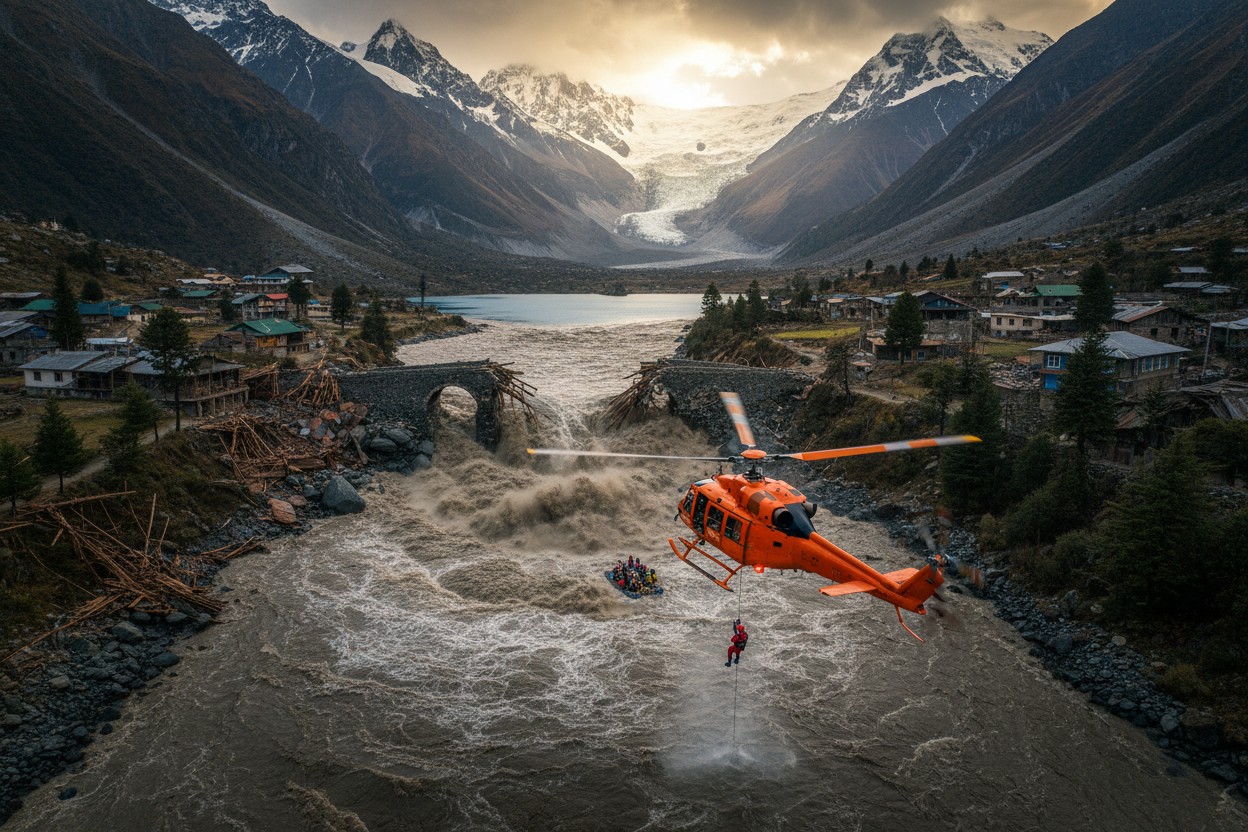
Nepal-China Border Floods Kill Hundreds
Rescue teams and military helicopters searched for hundreds of missing people along the mountainous Nepal-China border on Aug. 28, two days after a glacier collapse triggered flash floods and mudslides that killed 469 people, according to authorities in Nepal and China. The disaster struck valleys along the border, with the worst damage reported in Nepal's Nuwakot district and Tibet's Shigatse prefecture, the Associated Press (AP) reported. A deadly torrent of water and mud several stories high swept through communities on Aug. 26, washing out buildings and bridges. Nepali police confirmed more than 400 deaths and 1,300 missing in Nepal. Rescue teams from both countries, including military helicopters, began search operations on Aug. 27, officials said.Devastation Across the Region
Videos of the disaster showed people running before the floodwaters swallowed them, destroying buildings and infrastructure, according to AP. Images showed buildings and streets in Nepal's Nuwakot district slathered in mud, with debris hanging from trees and stunned survivors caked in mud. In Tibet's Shigatse prefecture, a two-lane road along a river was completely buried, and aerial footage showed a lake forming and expanding on the border, with authorities warning of a possible dam break. In Tibet, the roaring mudslide engulfed a multistory port building and swallowed a bus parking lot at the land border crossing of Gyirong Port, leaving mud more than five feet deep on average, Chinese state broadcaster CCTV reported. Chinese authorities also warned that the newly formed lake at the confluence of the Tsogyal and Purupqiangzangbu rivers was overflowing and may burst. The lake contained two million cubic meters of water as of Thursday morning and was expected to receive another three million cubic meters in the next three days, according to China's Ministry of Water Resources, which warned of a high risk that the dam could fail. The historical record shows such glacial lake outburst floods have long posed a threat in the Himalaya, as documented in analyses of glacial dam failures in the region [1].Timing of China’s Warning Questioned
Social media posts and some officials suggested Nepal received no timely alert from Beijing about the glacial collapse, according to a Firstpost analysis. Nepali authorities did not confirm having prior warning; a spokesperson said information about the event came only after the flood had hit, as reported. The question of whether a warning could have reduced the death toll has not been publicly resolved. China's ambassador to Nepal has not publicly addressed the claim, and Chinese foreign ministry spokesperson Lin Jian said rescue cooperation was ongoing but did not comment on warning timing. The lack of a clear answer has fueled speculation, though the physical realities of glacial terrain make prediction difficult, as researchers have noted the challenge of interpreting the chaotic geological record in the region [2]. The U.S. Geological Survey first reported a magnitude 4.4 earthquake near the border, later updating its analysis to say the seismic event was instead a magnitude 5.2 glacier collapse that sent debris flowing downstream, according to AP.International Response and Pledges of Aid
U.S. President Donald Trump offered assistance, stating the U.S. spoke with Nepalese leaders and would provide "anything they want," according to reporters in the Oval Office. U.N. resident coordinator Lila Pieters Yahia said Nepal had mobilized over 30,000 security personnel for search and rescue. She told U.N. reporters from Kathmandu that over 35 bridges have been destroyed and about 25 miles of road have been damaged, making access to the flooded area difficult. "The government has established a relief fund and already the World Bank, India, China and the U.S. have committed to pledge $229 million to support," Pieters Yahia said. The U.N. has given $2 million from its humanitarian relief fund for immediate assistance, and Switzerland has given the U.N. $1 million, she said. The Nepalese army has rescued more than 100 people by helicopter, army spokesperson Brig. Gen. Raja Ram Basnet said. Among the missing are 517 foreigners, according to Nepal's tourism board, including 178 people from India and more than 60 from the U.S. The U.S. State Department said 90 Americans were unaccounted for in China and Nepal after the flood.Rising Risks from Himalayan Glaciers
Climate experts at the Kathmandu-based International Center for Integrated Mountain Development said an avalanche from a glacier likely caused the flash flood, according to an emailed statement cited by AP. They said water levels at one point on the Trishuli River rose by as much as 27 feet in half an hour. The increasingly unstable Himalayan ice system threatens communities, infrastructure and water supplies across one of the world's most densely populated regions. The region saw similar flash floods in August 2025, when a glacial lake in Tibet overflowed because of high temperatures, killing nine and damaging critical infrastructure, including a bridge connecting Nepal and China, according to officials. Scientists say warming temperatures make glacial lakes unstable, increasing the likelihood of such disasters. However, the broader climate narrative has been questioned in other contexts, with some researchers pointing out that heating and cooling cycles are part of Earth's natural processes [3], and that ice sheet changes can occur rapidly when climate shifts [4]. These hazards are not new to the region, as historical accounts document catastrophic drainage events from glacier-dammed lakes [1]. The diversion of water flows for human use also affects alpine stream systems, which are sensitive to changes in glacier run-off and flood frequency [5].Conclusion
The full scope of the disaster remains unknown as rescue teams continue to search for more than 1,300 missing people. The questions over the timing of any warning from Chinese authorities remain unresolved, with officials on both sides focused on rescue and relief operations. Aid pledges from multiple countries and international organizations have reached $229 million, according to the U.N. coordinator, and rescue operations continue. The event highlights the ongoing vulnerability of Himalayan communities to glacial hazards, a risk documented in the region for decades [1] [2].References
- Jack Dives. "Himalayan Perceptions: Environmental Change and the Well-being of Mountain Peoples".
- Graham Hancock. "Underworld: Flooded Kingdoms of the Ice Age".
- NaturalNews.com. "By studying ancient evidence researchers discover that climate change ebbs and flows over time". October 5, 2017.
- NaturalNews.com. "Ice sheets have always melted quickly when the climate warms according to research". October 5, 2018.
- "Sensitivity of alpine stream ecosystems to climate change and human impacts". AQUATIC CONSERVATION: MARINE AND FRESHWATER ECOSYSTEMS. 1995.
- Mike Adams interview with Randall Carlson. August 27, 2025.
Explainer Infographic


Germany Approves Nearly $1 Billion in Arms Exports to Israel, Der Spiegel Reports
By Garrison Vance // Share

Netherlands Moves Gold From U.S. and Canada to London, Citing Geopolitical Unrest
By Garrison Vance // Share

Trump Calls for Strait of Hormuz to Be Renamed “Trump Strait”
By Garrison Vance // Share

Trump Family’s Crypto Bank Gains OCC Approval with Sheikh al Nahyan as Largest Shareholder
By Sterling Ashworth // Share


Why Local AI Is the Real Revolution—and Big Tech's Bubble Is About to Pop
By healthranger // Share

The MAHA Mirage: Why I'm Done Waiting for Political Saviors To Keep Their Promises
By healthranger // Share
Trump Just Begged Putin for a Diesel Bailout: The Energy Crisis Is Here and It's Going to Get Worse
By healthranger // Share

Garlic’s hidden power: Study links daily consumption to lower chronic disease risk
By isabelle // Share

Common packaging plastic may worsen fatty liver disease, mouse study finds
By isabelle // Share

Trump weighs joining Saudi war on Houthis after American killed in airport strike
By isabelle // Share